Our yearly training on using phyphox in physics teaching is now open for registration. Friday, 6th September, Aachen.
More information and the registration form can be found here.(in German)
Our yearly training on using phyphox in physics teaching is now open for registration. Friday, 6th September, Aachen.
More information and the registration form can be found here.(in German)
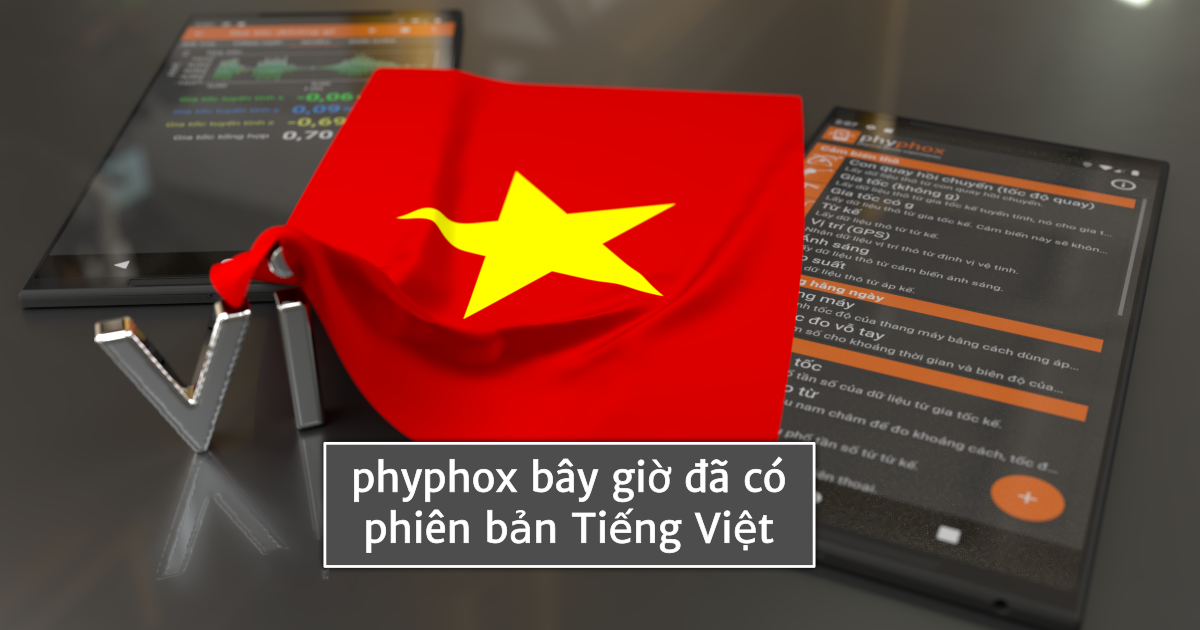
There is one more addition introduced with phyphox 1.1.0, which we would like to highlight separately as we were afraid that it might be overlooked among all the new features: The Vietnamese translation created by Nguyen Truong Vu from Phoenix Education in Hue. Thanks a lot for helping us to offer our app to users around the world!
More information about our voluntary translators and available languages can be found on our languages page.
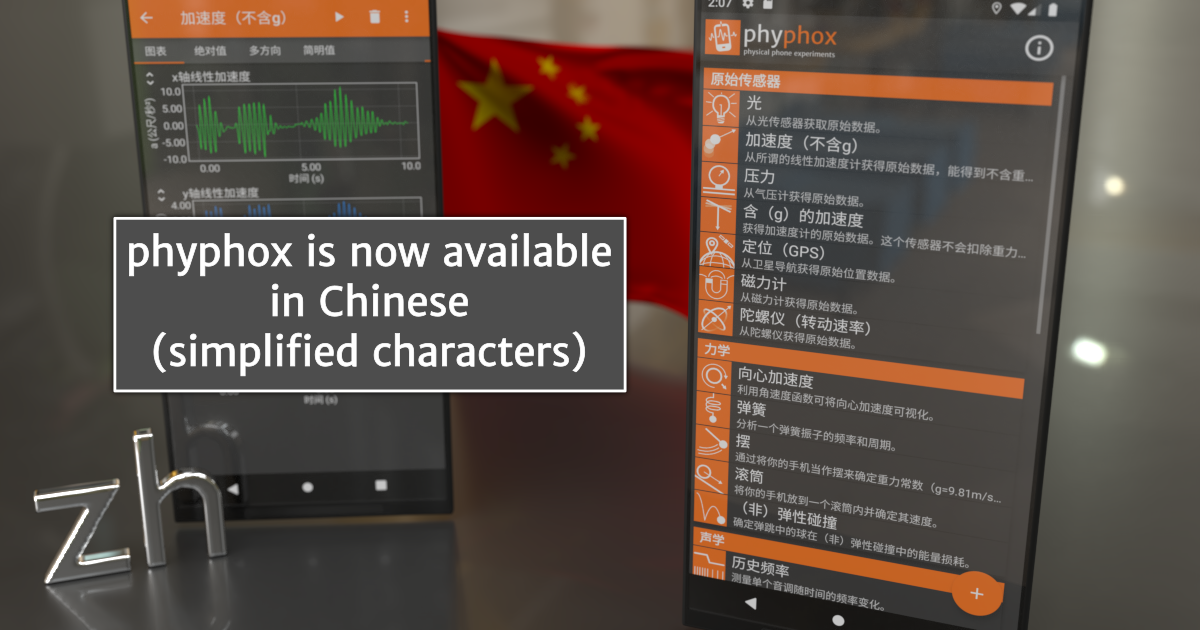
Phyphox 1.1.0 did not just introduce a ton of new features but also several translations which we feature separately to give due credit to our translators. One of these translations is Chinese (with simplified characters, to be precise) provided by Changcheng Ju (Nanjing University). Thanks a lot for your help!
More information about our voluntary translators and available languages can be found on our languages page.
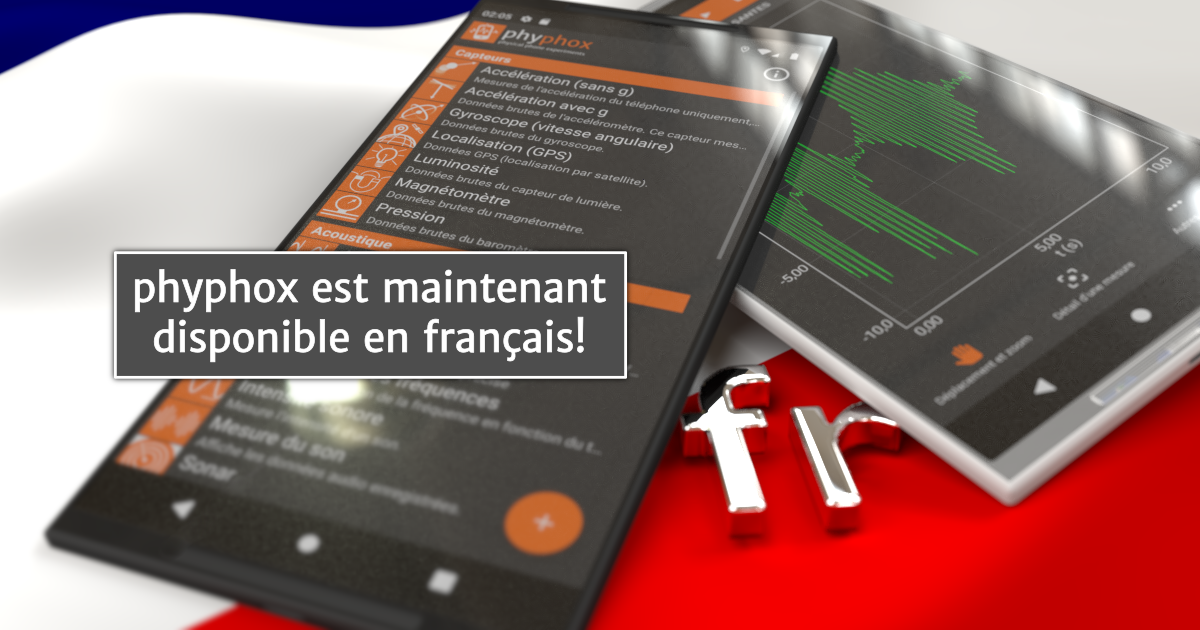
French-speaking users certainly have already noticed that we have released the French translation with Monday’s update to version 1.1.0. Still, we wanted to post a separate news entry to thank our voluntary translators for their help to translate phyphox into their language as the French translation was provided by Julien Basset (Université Paris-Sud), Frédéric Bouquet (Université Paris-Sud) and Ulysse Delabre (Université de Bordeaux).
More information about our voluntary translators and available languages can be found on our languages page.
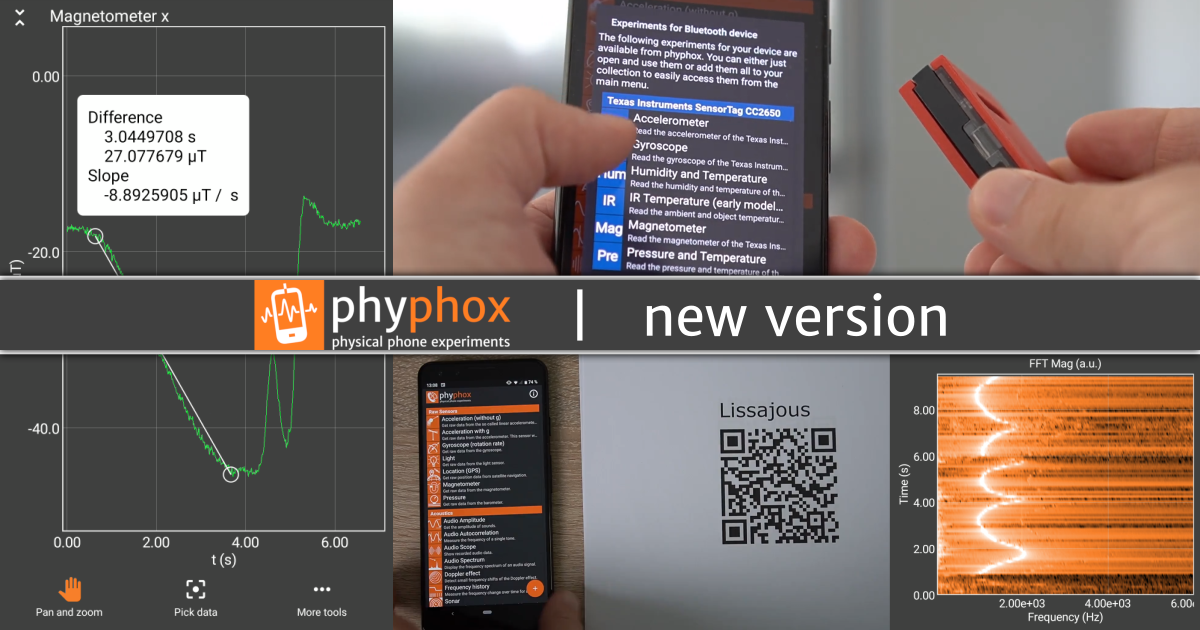
Finally, after much more time than anticipated, the big update has been released: Version 1.1.0
This one includes interactive graphs (zooming, picking points, measuring differences between points), new graph types (multiple data sets, bar charts, color plots), experiment transfer via QR codes and an extremely versatile Bluetooth Low Energy interface.
We could write entire articles on each of these and there are so many more improvements and small details… Well, here is a video with a quick overview of the big ones.
If this is not yet enough for you, here is the full changelog:
It took us much longer than expected to bring the new features to iOS. In the meantime Apple has introduced public beta testing, so now everybody can try out the new features.
Please help us to find the last bugs, so we can publish a perfect version in a few weeks. Please report any problems in our forums or via email.
You can find instructions on how to get the test version on our download page.
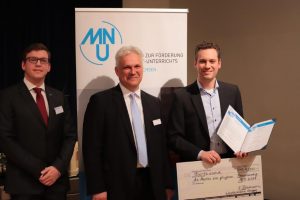 The phyphox team has been awarded the “Archimedes award” 2019 by the “Verband zur Förderung des MINT-Unterrichts” (MNU, loosely translated: association to forward STEM education). The award entails 4,000€ sponsored by the Westermann group. It is awarded yearly, alternating in the fields of mathematics and physics, to decorate innovative concepts and teaching methods as well as particularly commited teachers.
The app has been developed at the 2nd Institute of Physics at the RWTH Aachen University under the direction of Prof. Christoph Stampfer and Dr. Sebastian Staacks statt and it is being continuously refined in cooperation with the 1st Institute of Physics under Prof. Heidrun Heinke and a team of PhD students.
The award does not only mention the app itself, but the MNU emphasizes the value of the accompanying material like the demonstration videos. With more than 600,000 installations worldwide phyphox has been establish in many schools since its first release in September 2016.
Press release by the MNU
Press release by the RWTH Aachen University
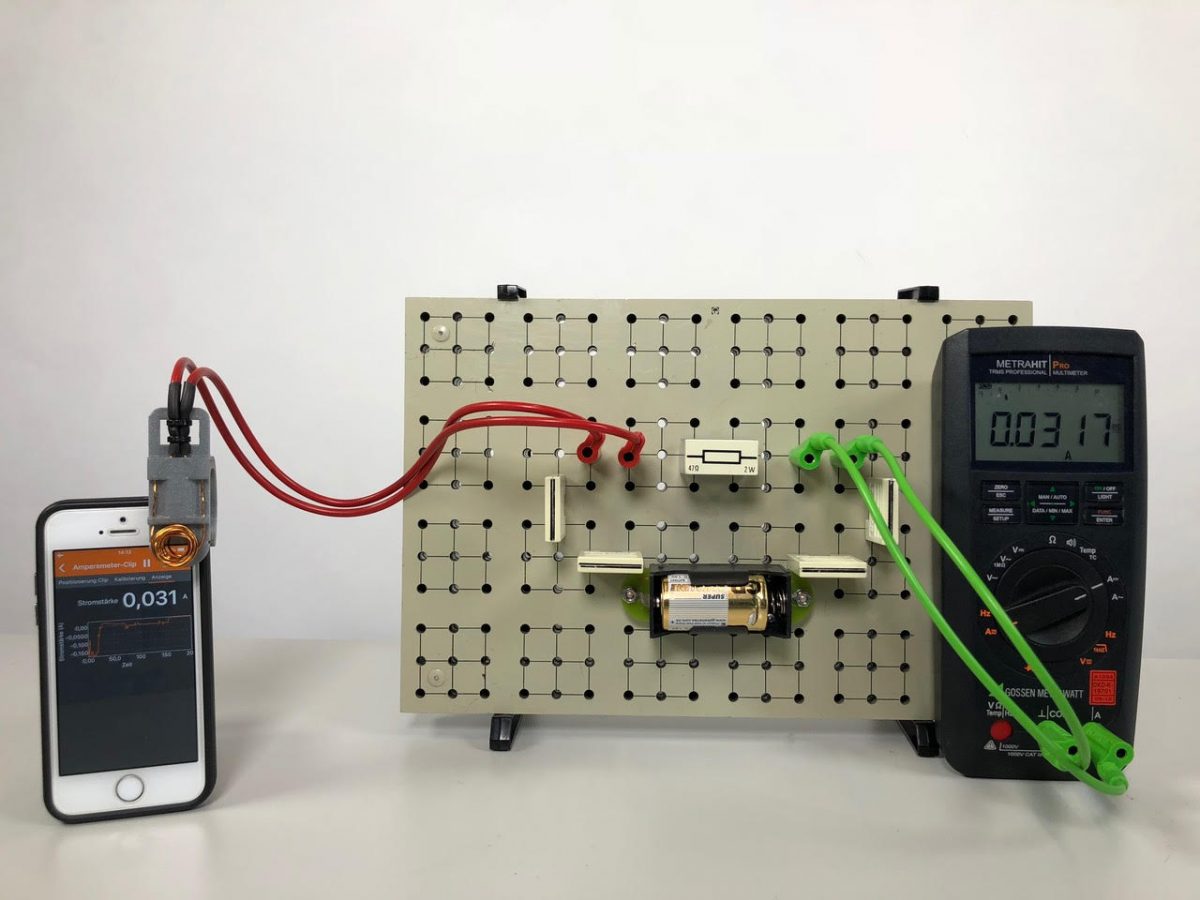
I’d like to share the work by Christoph Holz and Alexander Pusch from the University of Münster, who have created a 3D-printed coil that can be attached to the phone. This way, you can measure the current through the coil by measuring the resulting magnetic field. The have also created a phyphox experiment configuration, with which the coil can be calibrated, so you get a current-reading directly in phyphox.
This has been published in German in Naturwissenschaft im Unterricht Physik, 169, S.46-47 and a short version (also in German) can be read on physikkommunizieren.de. The phyphox configuration is listed and explained in English in our wiki.
Thanks to Wakana Okita and Keisuke Takashima phyphox now speaks Japanese. More information about our voluntary translators can be found on our languages page.
I have been asked if phyphox can do Lissajous curves. Well, of course it can.
If you want to try it yourself, just open the following link on a smartphone with phyphox:
Lissajous oscilloscope